
Smoke Detector vs Heat Detector Installation: Which Goes Where?
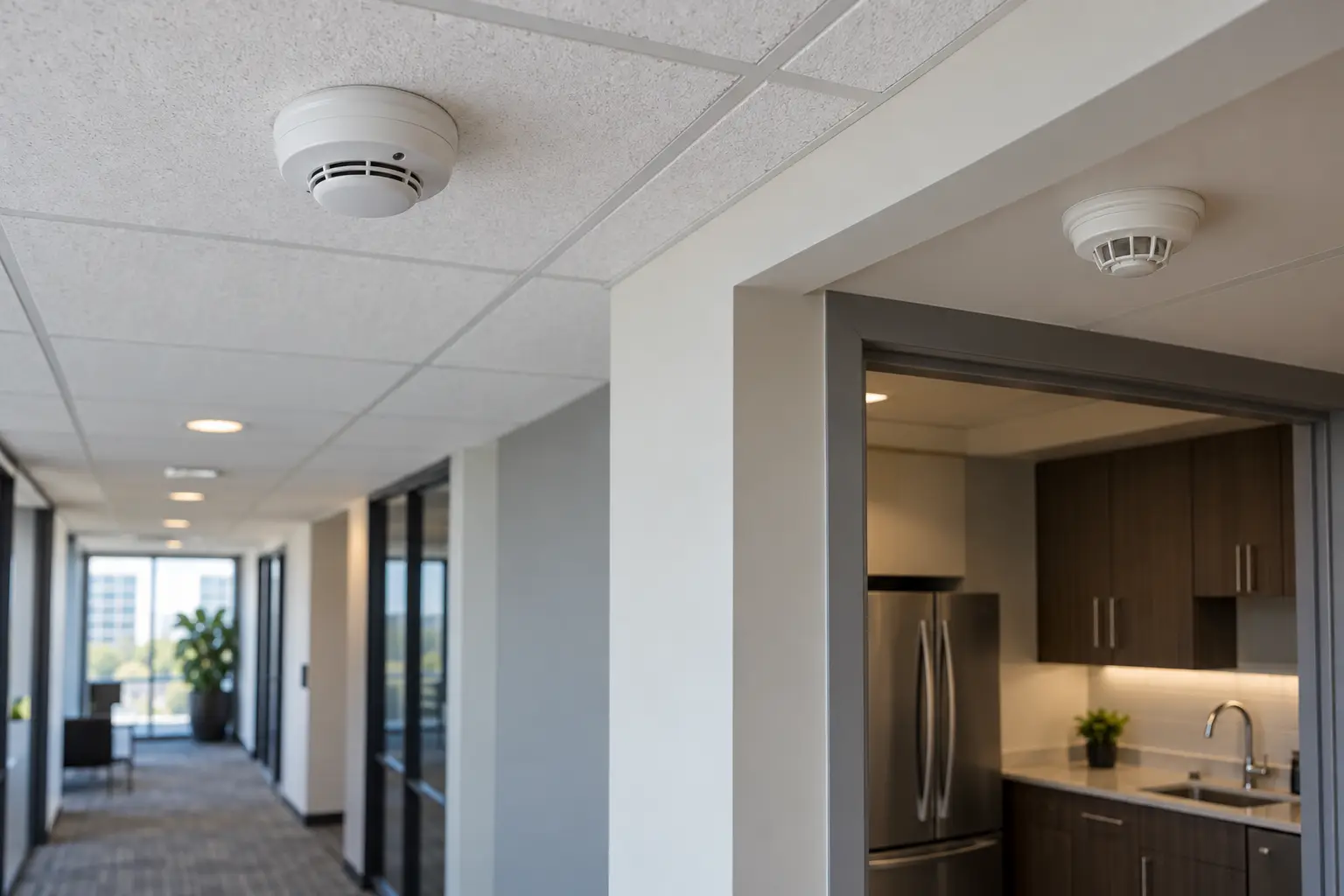
TL;DR: Smoke detectors give the earliest warning, so they belong in most occupied spaces. Heat detectors belong in kitchens, garages, attics and loading docks, where smoke, steam, dust or heat would set off false alarms. Codes allow heat detection in place of smoke detection only where conditions rule smoke detectors out, and the fire marshal has the final say.
Smoke detectors go in most occupied spaces because they warn people sooner. Heat detectors go where steam, cooking fumes, dust or high heat would cause false alarms, like commercial kitchens, garages, attics and loading docks. Most Houston buildings need both types, laid out to NFPA 72 and approved by the fire marshal.
This guide covers smoke detector vs heat detector installation in plain terms: how each device works, where each one belongs, and when the code lets you use one in place of the other.
What is the difference between a smoke detector and a heat detector?
A smoke detector senses smoke particles in the air. A heat detector senses temperature. Everything else follows from that one difference.
Smoke usually shows up before a room gets hot. That is why smoke detectors give the earliest warning in offices, corridors, apartment hallways and patient areas. The U.S. Fire Administration notes that heat alarms respond to high temperatures, not to smoke.
Commercial heat detectors work in two ways. A fixed-temperature detector trips when the air around it reaches a set point. A rate-of-rise detector trips when the temperature climbs fast, even if it has not reached the set point yet. Many detectors do both. For example, Kidde’s data sheet for its multisensor heat and CO detector lists a 135°F fixed rating and a rate-of-rise rating of 15°F per minute.
Smoke detector vs heat detector installation: where does each go?
Put smoke detection where people live, work and sleep. Use heat detection where normal conditions would fool a smoke sensor. Here is how the main options compare.
| Detector type | What sets it off | Warning speed | Common spots in Houston buildings |
|---|---|---|---|
| Photoelectric smoke | Smoke particles in the air | Earliest for most fires | Corridors, offices, apartment hallways, patient rooms, electrical rooms |
| Fixed-temperature heat | Air reaching a set temperature | Slower; waits for heat to build | Unconditioned attics, mechanical rooms, storage areas |
| Rate-of-rise heat (often combined with fixed) | A fast climb in temperature | Quicker than fixed heat on fast, flaming fires | Restaurant kitchens, break rooms, parking garages, loading docks |
| Heat plus CO multisensor | Heat and carbon monoxide | Same as heat, plus a CO warning | Spaces near fuel-burning equipment |
Kitchens cause the most trouble. NFPA 72 has long kept smoke alarms away from cooking equipment. According to UL Standards and Engagement, the 2025 edition says smoke alarms and smoke detectors generally cannot go within a 10-foot radius of a fixed cooking appliance. Between 10 and 20 feet along the path the air travels, they must be listed as resistant to cooking nuisance alarms. That is why a restaurant cook line or an office break room often gets a heat detector instead. Ask your fire alarm company which edition your fire marshal enforces.
How do Houston heat and humidity change the choice?
Houston’s climate puts more spaces into heat detector territory. Long, hot summers and heavy humidity are hard on devices in any space without air conditioning.
The USFA says smoke alarms in garages can go off because of changes in temperature and humidity, as well as dust, fumes and insects. Heat alarms are built to ignore those conditions. The same logic applies to apartment parking garages, warehouse loading docks and the attics above strip centers from Jersey Village to Pearland. Honeywell’s application guide for system smoke detectors also lists attics, closets and areas under open loading docks as places where a heat detector may fit better. It adds that smoke detectors in very dusty spaces can need more maintenance.
The temperature rating matters too. A heat detector has to be rated above the hottest normal temperature in the room, or it can trip on a summer afternoon. For home garages, the USFA recommends heat alarms rated between 175°F and 250°F, because garage temperatures can rise above 100°F. In a commercial system, the designer matches each detector’s rating to its space. That deserves a second look in a metal-roof warehouse in August.
Can a heat detector replace a smoke detector?
Only where a space is not suitable for smoke detection. In an occupied room, a heat detector cannot stand in for a smoke detector as a life-safety device.
Section 907.4.3 of the International Building Code calls for smoke detection where automatic detection is required. It allows heat detectors only when the environment is not suitable for smoke detectors. NFPA 72 takes the same approach at the fire alarm control panel. As Electrical Contractor magazine explains, the panel location needs a smoke detector, and a heat detector is allowed only where conditions rule smoke detection out.
Insurers see it the same way. Chubb, for example, describes heat sensors as an option for spots where smoke detectors won’t work, not a substitute for them. In Houston, your fire marshal (the authority having jurisdiction) has the final word on any substitution. For the full design picture, see our guide to commercial fire alarm installation requirements under NFPA 72.
What are the pros and cons of heat detectors?
Heat detectors trade speed for fewer false alarms. Here is the short version.
- Pro: Very few false alarms from steam, cooking fumes, dust, vehicle exhaust or humidity.
- Pro: They hold up in hot, dirty or unconditioned spaces where smoke detectors struggle.
- Pro: Rate-of-rise models respond quickly to fast, flaming fires.
- Con: Slower warning, because a fire has to produce real heat first. A smoldering fire can fill a room with smoke before a heat detector trips.
- Con: They are not accepted in place of smoke detection where people need early warning.
- Con: The wrong temperature rating means false alarms in hot spaces or a late alarm in cooler ones.
Smoke detectors are the mirror image. They give the earliest warning, but they cause more nuisance alarms in harsh spaces.
Why do Houston property managers call Spartan Fire Protection for detector work?
Choosing the right device for each room is a design decision, and mistakes show up at inspection. Here is what we bring to the job.
Spartan Fire Protection is a licensed Kidde dealer, and our technicians supply and install Kidde panels, smoke detectors and heat detectors.
We install fire alarm systems to NFPA 72 and the local fire marshal’s requirements, and the permit is part of the installation.
We often help businesses clear fire marshal deficiencies that another company left behind.
We run annual inspections for apartment and commercial properties, and we do extended system testing when a building needs it.
We are members of the Houston Apartment Association, the Texas Apartment Association and the National Apartment Association.
We are highly rated on Google and were named BusinessRate Best of 2025 and Best of 2026 for fire protection service in Houston.
In a Google review, a customer named Caroline wrote, “They are knowledgeable and will only sell service and products that you need.”
We serve Greater Houston and surrounding communities. To learn more, see our pages on commercial fire alarm systems in Northwest Houston and commercial fire alarm systems in Spring Branch.
Not sure which detectors your building needs to stay inspection-ready? Call Spartan Fire Protection at (713) 955-4405, Monday through Friday from 8 AM to 4 PM, or get a free commercial fire alarm system quote.
Frequently Asked Questions
Do Houston restaurant kitchens need heat detectors instead of smoke detectors?
It depends on how the fire alarm system is designed and what the fire marshal approves. NFPA 72 keeps most smoke detectors out of a 10-foot radius around fixed cooking equipment, so kitchen areas on the alarm system often use heat detection instead.
Can I swap a smoke detector for a heat detector to stop false alarms?
Not on your own. A commercial fire alarm system follows an approved layout, and changing device types can create a code deficiency. A licensed fire alarm company should review the space, and the fire marshal may need to approve the change.
What kind of heat alarm should go in a home garage in Houston?
The U.S. Fire Administration recommends a hardwired heat alarm with battery backup, rated between 175°F and 250°F, that interconnects with your smoke alarms. It should be installed by a qualified electrician or fire alarm professional.
Can one device detect both heat and carbon monoxide?
Yes. Kidde makes a multisensor detector that combines rate-of-rise and fixed-temperature heat sensing with carbon monoxide detection. It can be a good fit near fuel-burning equipment.
Recommended Reads
- Commercial Fire Alarm Installation Requirements Under NFPA 72
- Houston Fire Protection Company | Spartan Fire Protection
- POTS Line Shutdown: Fire Alarm Monitoring Houston TX