
POTS Line Decommissioning and Fire Alarm Monitoring: What Houston Businesses Need to Know
If your commercial building has a fire alarm system that still communicates through a traditional phone line, that setup is on borrowed time. Landline phone providers across the country are actively retiring their copper infrastructure, and Houston-area buildings are not exempt. When your POTS line goes away, your fire alarm system loses its ability to reach the monitoring station, which means your building may not get the response it needs when it matters most.
Here is what is happening, what it means for your property, and how Spartan Fire Protection can help you stay protected and code-compliant.
What Is a POTS Line and Why Does It Matter for Fire Alarms?
POTS stands for Plain Old Telephone Service. It refers to the standard analog copper landlines that have been part of the telephone infrastructure for decades. Many commercial fire alarm systems were originally installed to use these lines as their primary communication pathway, sending signals to a central monitoring station when an alarm is triggered.
For years, this was the standard. But the technology is aging out. Major carriers including AT&T have begun decommissioning copper facilities, and the trend is accelerating. AT&T started shutting down copper at hundreds of wire centers in 2026, with plans to retire most of its copper network by the end of 2029. Other carriers are following similar schedules.
Once a copper line is decommissioned at a given location, there is no restoring it. The physical infrastructure is simply gone.
What Happens to Your Fire Alarm When a POTS Line Fails?
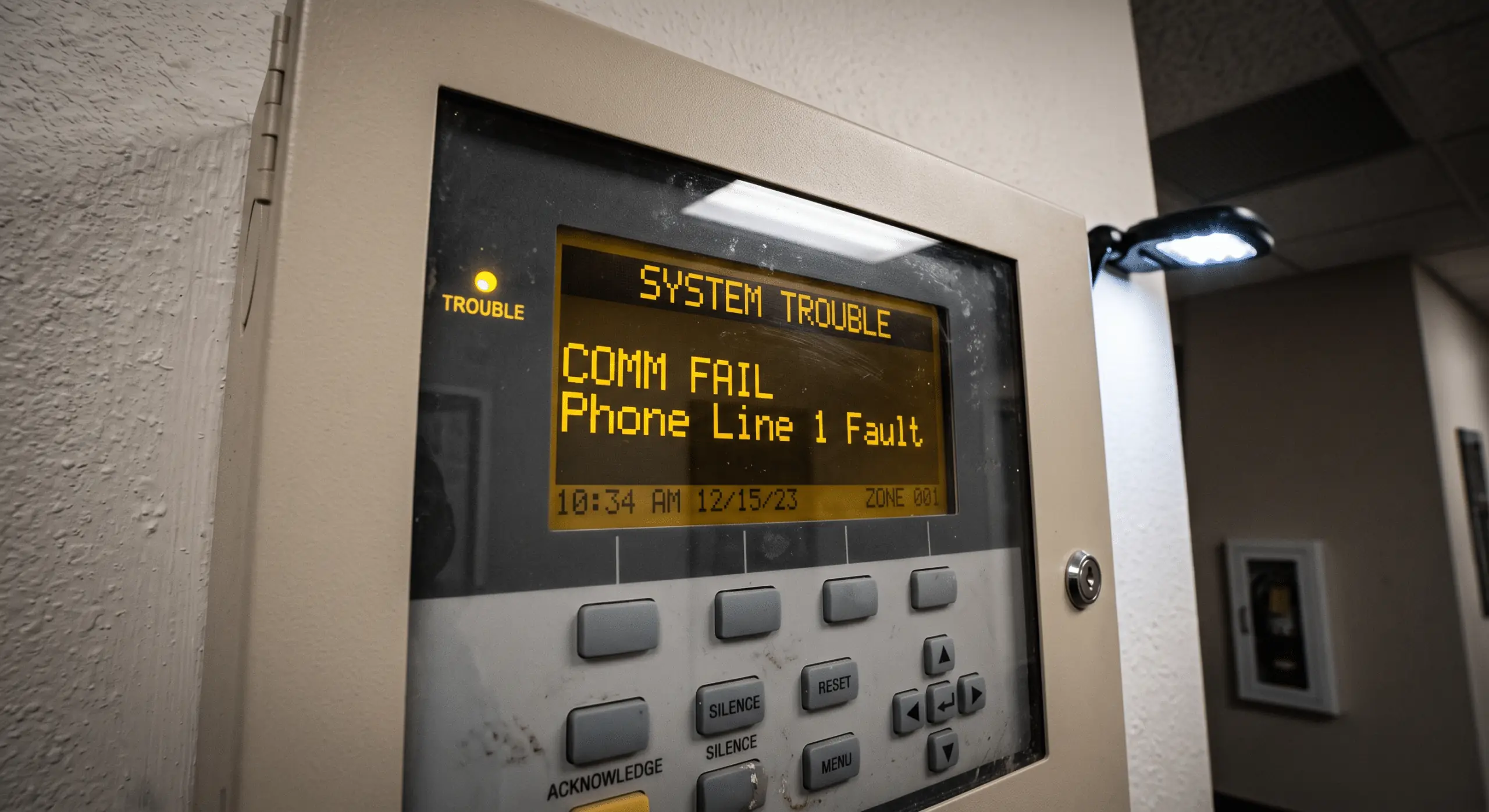
When the phone line your fire alarm relies on stops working, the panel will typically display a “Comm Fail,” “Communication Failure,” or “Phone Line Trouble” message. The yellow trouble indicator illuminates, and the panel’s buzzer sounds.
This is important to understand: your horns, strobes, and local devices still work. If smoke is detected, the alarms will sound inside the building. But without a functioning communication path, the signal that alerts your monitoring station, and triggers a call to the fire department, never goes out.
There is a second problem that makes this worse. Traditional POTS-based systems only check in with the monitoring station once every 24 hours. If your phone line fails at midnight, the monitoring station may not discover the problem until the following night. In the meantime, your building is unmonitored without anyone knowing it.
From a code compliance standpoint, a building without a functioning communication path is out of compliance with NFPA 72. Your Authority Having Jurisdiction (AHJ) may require corrective action, and your insurance carrier may have questions as well.
The Solution: Cellular Communicators for Fire Alarm Monitoring
A cellular communicator replaces the phone line with a wireless connection to the monitoring station. Instead of relying on copper wiring through a carrier’s aging infrastructure, the system transmits signals through a cellular network, independently of your building’s internet or phone service.
Cellular communicators offer several meaningful improvements over POTS lines:
Faster signal delivery. Cellular units transmit alarm signals in under a second. A traditional POTS dialer can take 30 to 90 seconds to complete a call and handshake with the monitoring station.
More frequent supervision. Cellular communicators check in with the monitoring station every five minutes, compared to once every 24 hours with a traditional POTS setup. If something goes wrong, it gets caught quickly.
Independence from building infrastructure. A cellular communicator operates entirely on its own. It is not affected by internet outages, router failures, or power issues on the network side of your building.
No landline costs. POTS line fees have been climbing significantly in recent years as carriers retire the infrastructure. Eliminating that line removes a recurring expense that has no ceiling as long as the line exists.
Spartan Fire Protection installs StarLink cellular communicators by Napco Security Technologies. StarLink is a universal LTE communicator compatible with virtually any fire alarm control panel and operates across major cellular networks including AT&T, Verizon, and T-Mobile. It supports both cellular-only and dual-path cellular/IP configurations, giving your building a reliable, code-compliant connection to our UL-listed central monitoring station.
How the Upgrade Process Works
Spartan keeps the process straightforward for building owners and property managers.
Step 1: Panel photo. Before scheduling a site visit, we ask for a photo of your fire alarm control panel. This lets our team evaluate the panel and confirm which communicator is compatible with your system.
Step 2: Site assessment. Once on site, our technician verifies cellular signal strength at the panel location. Signal strength matters for reliable communication, and we confirm it before proceeding.
Step 3: Installation and programming. The technician installs the cellular communicator, programs it to communicate with our central monitoring station, and connects it to your fire alarm system.
Step 4: Full system test. Before the job is complete, we test the entire communication path from the panel to the monitoring station. You receive documentation confirming the upgrade and your monitoring account status.
From start to finish, most communicator upgrades are completed in a single visit. Additional work may be needed depending on panel age, site conditions, or any existing issues found during the assessment.
What “Comm Fail” Means If You See It Today
If your fire alarm panel is currently displaying a “Comm Fail,” “Phone Line Trouble,” or similar communication fault, your monitoring pathway has already been interrupted. This could be due to a carrier change at your wire center, a billing lapse on a POTS line account, or physical line damage.
Do not assume the alarm will reach the monitoring station until that fault is cleared and tested. Contact a licensed fire alarm technician to evaluate the situation and restore your communication path as quickly as possible.
Spartan Fire Protection offers same-day service for alarm communication failures. Call us at (713) 955-4405 and we will get a technician out to your property.
Why This Affects Houston Buildings Now
Houston sits in a major AT&T service footprint, and the decommissioning of copper lines is already underway in Texas. Wire center retirements are rolling out geographically, and buildings in affected areas typically receive a 180-day discontinuance notice before the line is shut off. In practice, many building owners do not realize the notice has been issued until the trouble message appears on their panel.
If your fire alarm system was installed more than five to ten years ago and has never had a communicator upgrade, there is a reasonable chance it is still relying on a POTS line. A quick call to Spartan or a look at your panel can confirm what communication method you are currently using.
Stay Monitored and Code-Compliant
Spartan Fire Protection provides 24/7 UL-listed central station monitoring for commercial properties throughout Greater Houston. Our monitoring service works with cellular communicators to deliver fast, reliable signal transmission and immediate dispatch coordination.
As a Licensed Kidde Fire Alarm Systems dealer with more than a decade of experience serving Houston, we handle everything from the initial assessment through installation, testing, and ongoing monitoring. Our technicians are certified and familiar with the code requirements that apply to Houston-area commercial properties under NFPA 72 and local AHJ guidelines.
If you are not sure whether your system is ready for the POTS transition, or if you have already seen a communication fault on your panel, the best next step is to get it evaluated now, before an emergency exposes the gap.
Contact Spartan Fire Protection to schedule an assessment, or call us directly at (713) 955-4405. You can also learn more about our monitoring services and how our central station keeps your property protected around the clock on our 24/7 fire alarm monitoring page.
Related Articles
Understanding The Different Types of Fire Sprinkler Systems
Explore various fire sprinkler systems—wet, dry, pre-action, deluge, and foam—to determine the best fit for your facility’s specific fire protection needs.
How To Clean Up Fire Extinguisher Residue
Learn effective methods to safely clean different types of fire extinguisher residues, ensuring your space is restored and hazards are minimized.