
Commercial Fire Alarm Installation Requirements Under NFPA 72
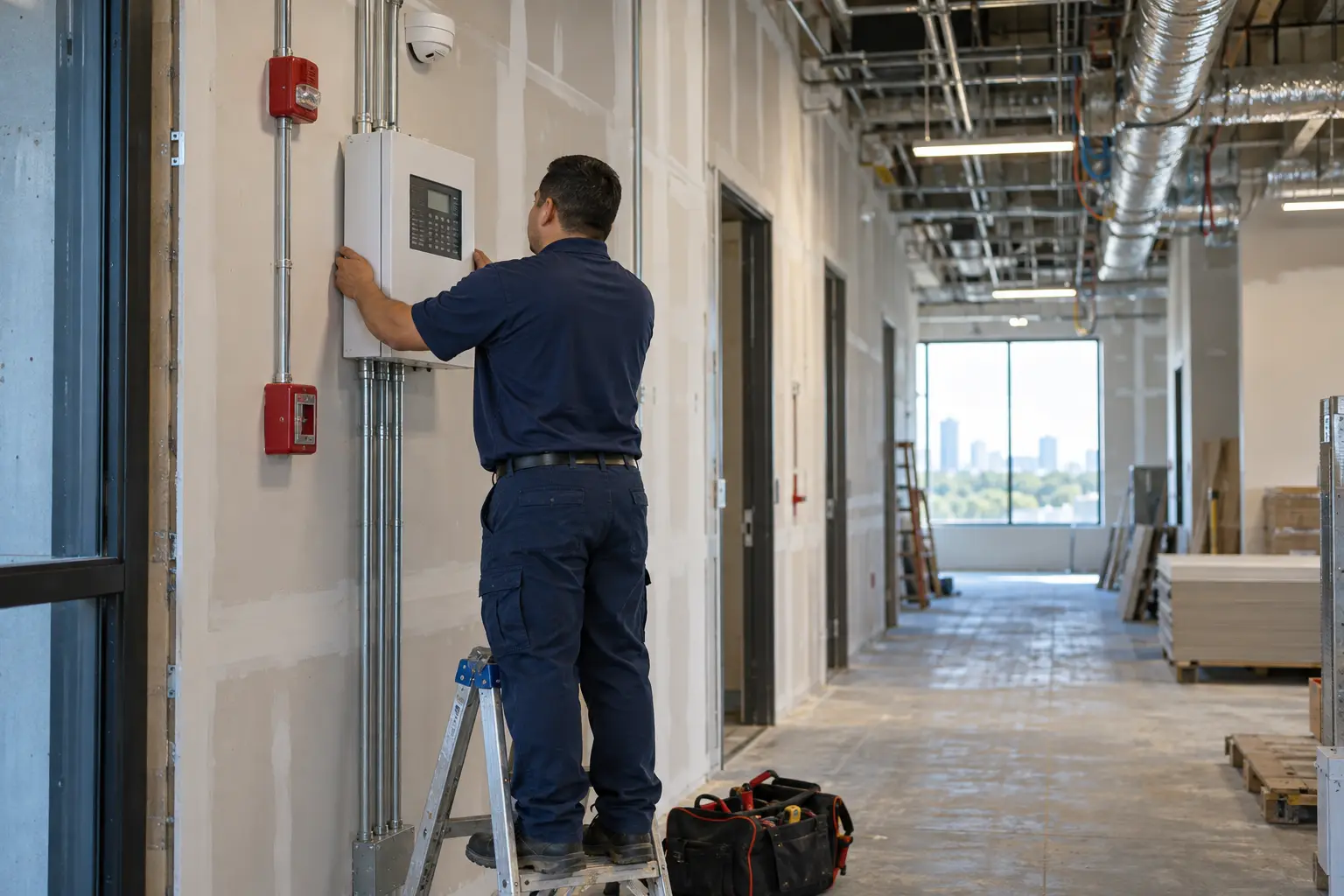
TL;DR: NFPA 72 sets the rules for how a commercial fire alarm is designed, installed, powered, monitored and tested. Your local building and fire codes decide whether you need one in the first place. In Houston, the Fire Marshal’s Office reviews the plans and inspects the work, Texas requires licensed and registered installers, and monitored systems need an annual city fire alarm permit.
Under NFPA 72, commercial fire alarm installation requirements come down to five things: a design that fits your building, an approved permit, correct wiring and device placement, backup power and monitoring, and a final acceptance test. In Houston, the city’s Fire Marshal’s Office reviews the plans and inspects the finished work.
Below, we walk through each step. We also cover the details that slow down projects in Houston and nearby cities like Pearland, and the signs that your building needs a new system or an upgrade.
What do NFPA 72 commercial fire alarm installation requirements cover?
NFPA 72 covers how a fire alarm system is designed, installed, tested and maintained. It does not decide whether your building needs one. That call comes from the building and fire codes your city adopts. Those codes look at things like occupancy type, building size and how many people use the space.
NFPA 72 is a national standard published by the National Fire Protection Association. Federal, state and local governments adopt it as part of their fire codes. Its scope includes how fire alarm systems are installed and where devices go, how they perform, and how they get inspected, tested and maintained. It also covers supervising station (monitoring) systems.
In Houston, the Houston Fire Marshal’s Office handles plan review, inspections and compliance for commercial buildings. The city works from the 2021 International Fire Code with Houston amendments. NFPA 72 is the rulebook for how the alarm gets built. The fire marshal is the one who signs off on it.
What are the steps in a commercial fire alarm installation?
Most commercial installs follow the same path from first walkthrough to final sign-off. How long it takes depends on the building, the amount of wiring and the plan review queue.
- Site survey. A technician walks the building and notes what each room is used for, how high the ceilings are, and where people sleep, cook or gather. A restaurant kitchen, a medical suite and an apartment corridor each need different detection.
- Design and drawings. Device locations, wiring paths and battery calculations go on paper. The reviewer checks those drawings against NFPA 72 and local code.
- Permit and plan review. In Houston, a Fire Marshal’s Office team at the Houston Permitting Center reviews fire alarm plans. Installation follows approval.
- Rough-in wiring. Cable runs to every device location, ideally before ceilings close on a build-out.
- Devices, panel and programming. Detectors, pull stations, horns and strobes go up. The panel is programmed so each device reports its exact location.
- Monitoring connection. A communicator links the panel to a UL-listed central station so alarms reach help even when the building is empty.
- Acceptance testing and inspection. Every device gets tested, then the fire marshal inspects the system.
- Annual fire alarm permit. Houston requires a permit for monitored fire alarms. The city puts the system owner in charge of filing the application and keeping the permit on site. Forms are on the Houston Fire Department permits page.
Many owners feel lost at the permit step. One customer put it simply: ‘Andreya walked me through the permitting process for my fire alarm installation.’ (Ari)
Which NFPA 72 details trip up Houston projects?
Three items cause most delays and failed inspections: backup power, the monitoring connection and installer licensing.
Backup power
NFPA 72 requires secondary power that can run the system for 24 hours on standby, then sound every notification appliance for 5 minutes. The panel must also be able to fully recharge the batteries within 48 hours of a full discharge. Batteries are sized by calculation, not by guesswork, and the calculation belongs on the drawings. Houston storm season puts that 24-hour number to a real test.
The phone line problem
Copper POTS phone lines are being retired across Houston. Older panels that dial out over those lines lose their connection, and the panel shows ‘Comm Fail.’ A new install should not depend on copper at all.
| Communication path | How it sends alarms | What to know in Houston |
|---|---|---|
| Copper phone lines (POTS) | The panel dials the central station over landlines | Lines are being retired across Houston; a dead line means Comm Fail, and alarm signals stop reaching the monitoring center |
| Cellular communicator | Sends signals over a cellular network | The usual choice for new installs and POTS replacement; signal strength is checked where the panel is mounted |
| Radio communicator | Sends signals over a radio network | Worth a look where cellular signal inside the building is weak, such as steel-heavy warehouses |
Licensing
In Texas, the installing company must be registered for fire alarm work with the State Fire Marshal’s Office. The installing employee must hold a fire alarm license. The monitoring station must be registered too. You can confirm any company with the Texas Department of Insurance license lookup before you sign a contract.
Does the process change outside Houston city limits?
The NFPA 72 rules for building the system stay the same, but who approves it changes. Inside Houston city limits, the Houston Fire Marshal’s Office reviews plans and inspects. A building in Pearland or Jersey Village falls under that city’s own fire marshal or building official. Submittal steps and local amendments there can be different.
So confirm the authority having jurisdiction (AHJ) before design starts. A good installer checks this during the site survey. Within Houston, we install systems for office, retail and multifamily properties, including commercial fire alarm systems in Spring Branch and Uptown Houston commercial fire alarm systems.
When should you call a pro about your fire alarm?
Call a licensed fire alarm company when your system shows any of these signs:
- The panel reads Comm Fail or shows a communication trouble.
- Trouble signals clear, then come back days later.
- The fire marshal or your insurer listed deficiencies after an inspection.
- You are planning a remodel, tenant build-out or change in how the space is used. Houston publishes a procedure for remodeling buildings that have a required fire alarm system.
- The panel is old and replacement parts are hard to find.
- You took over a property and nobody can find past inspection records.
None of these are DIY fixes. Fire alarm work in Texas has to be done by licensed technicians working for a registered firm.
Why Spartan Fire Protection for a fire alarm install
Here are the plain facts.
- Spartan Fire Protection is a licensed Kidde dealer, and we install Kidde fire alarm panels and devices.
- We design and install to NFPA 72 and the local fire marshal’s requirements.
- We handle the fire alarm permit as part of the installation.
- We connect panels with StarLink cellular communicators, and monitoring runs through UCC, a UL-listed central station.
- We often help businesses pass fire marshal inspections after another company left deficiencies.
- Financing for installation projects is available through Hampton Ridge Financial.
- We are highly rated on Google and were named BusinessRate Best of 2025 and Best of 2026 for fire protection service in Houston.
Planning a new build-out or replacing an old panel? Call (713) 955-4405, Monday through Friday, 8 AM to 4 PM, or get a free commercial fire alarm quote.
Frequently Asked Questions
How long does a commercial fire alarm installation take in Houston?
It depends on the building’s size, how much wiring is needed, the construction schedule and the plan review queue. Your installer should be able to give you a realistic schedule after the site survey and drawings are done.
Who is responsible for the Houston fire alarm permit, the owner or the alarm company?
The City of Houston puts the alarm system owner in charge of filing the fire alarm permit application and keeping the permit at the property. Your fire alarm company can help you with the paperwork.
Can I add devices to my existing fire alarm panel instead of replacing it?
Often yes, if the panel is compatible and has room for more devices. NFPA 72 applies to additions and changes to existing systems, so the new work still has to meet code and may need a permit.
Does NFPA 72 cover carbon monoxide detection?
Yes. NFPA 72 covers CO detection when it is tied into the fire alarm system, and the old NFPA 720 CO standard was merged into NFPA 72 in the 2019 edition. Whether your building needs CO detection is up to your local code.
Recommended Reads
- Commercial Fire Alarm Systems in Spring Branch Houston
- Commercial Fire Alarm Systems in Northwest Houston, TX
- Fire Alarm Systems in Greater Heights, TX